How Independent Bookstores Came Back After Amazon
Small businesses compete with Amazon by not competing on what Amazon does best: price, endless choice, and fast delivery. They win on what a website can't do: being local, knowing what each customer wants, and bringing people together in one room. Independent bookstores proved it. Their numbers fell 43% in five years, and then they came back.
Here's what happened to them, what the research says they did, and how to use it if you don't sell books.
What happened to independent bookstores when Amazon arrived?
They were already in a tough spot. Harvard Business School's Working Knowledge puts it this way: "When Amazon.com burst onto the nascent online retail scene in 1995, the future seemed bleak for brick-and-mortar independent bookstores—which already faced competition from superstores like Barnes & Noble and Borders."
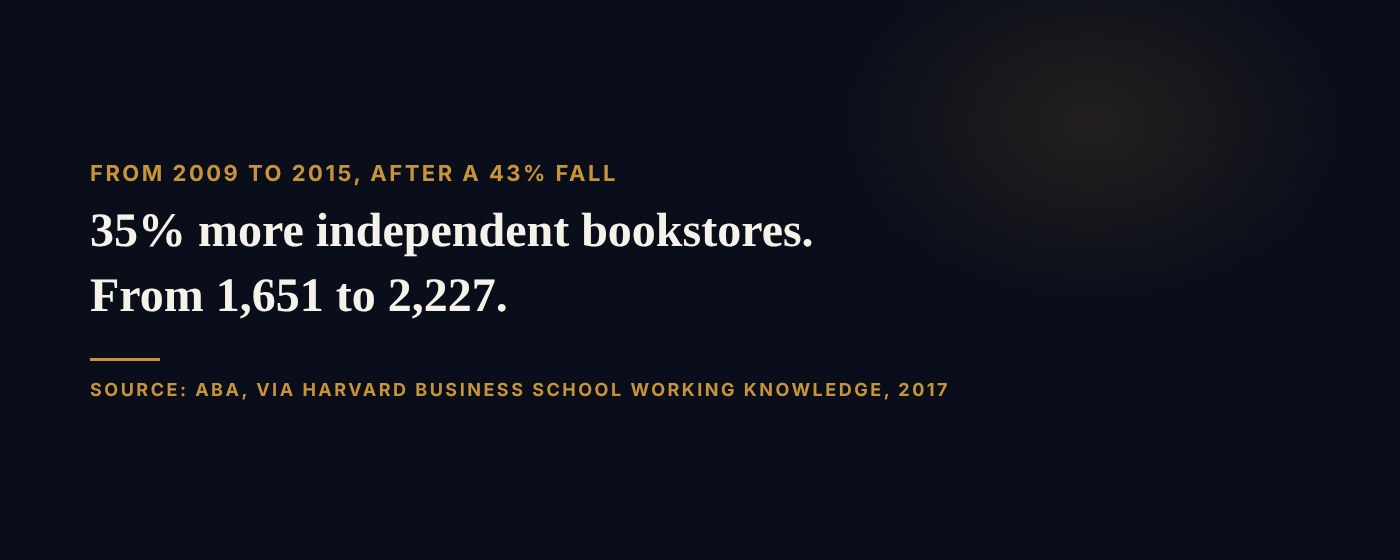
Bleak is the right word. Between 1995 and 2000, the number of independent bookstores in the US fell 43%, according to the American Booksellers Association (ABA), the trade group for independent bookstores.
Then a giant lost to a giant. "While pressure from Amazon forced Borders out of business in 2011, indie bookstores staged an unexpected comeback," the same article reports.
Did independent bookstores really come back?
Yes, and the numbers are not small. Between 2009 and 2015, the ABA reported 35% growth in the number of independent booksellers, from 1,651 stores to 2,227.
It kept going. A 2020 follow-up in Working Knowledge described the number "climbing 49 percent in the next decade to nearly 2,500 stores nationwide."
And it hasn't stopped. In its letter on 2025, the American Booksellers Association said its membership grew 19% that year, and "605 new brick-and-mortar, pop-up, and mobile stores opened across the US." That is the stores' own trade group counting, so read it as their number. But it points the same way.
This isn't a fairy tale. The 43% drop was real, and not every store came back. What the research shows is what the ones that grew did differently.
What did the bookstores do that Amazon couldn't?
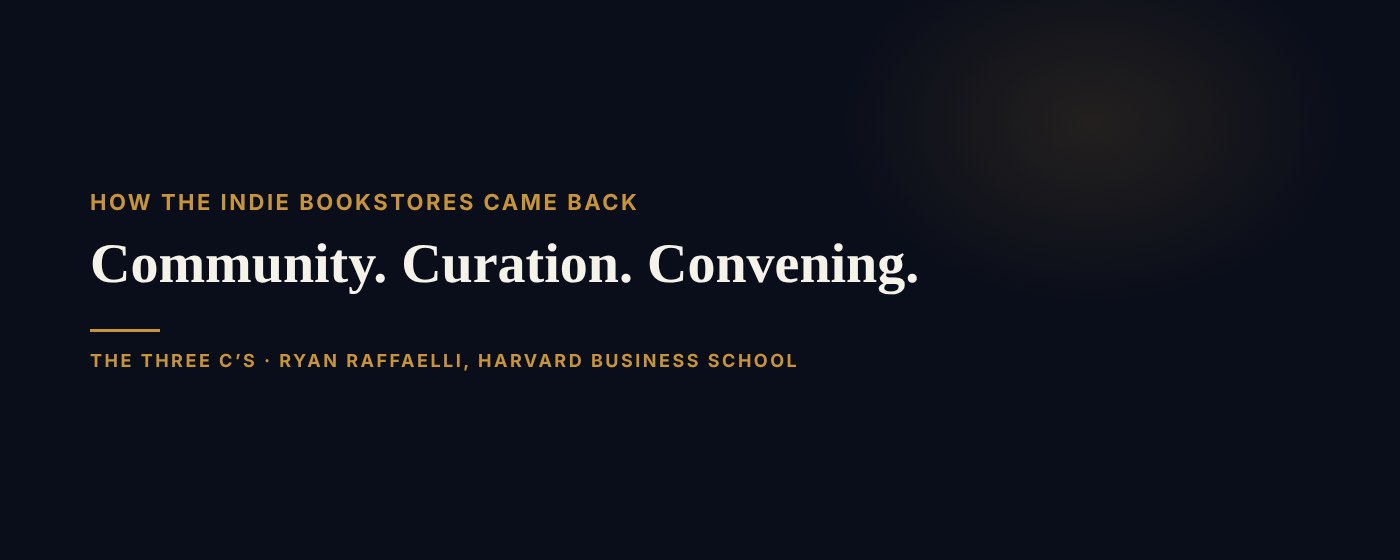
Ryan Raffaelli, a professor at Harvard Business School, studied the comeback for years. He sums it up as three C's: community, curation, and convening.
- Community. Indie stores were early champions of shopping local. They gave people a reason to buy: keep the store on your own street open.
- Curation. They stopped trying to stock everything. Booksellers picked books for the people who walked in, and helped them find authors they'd never heard of, not just the bestsellers.
- Convening. They made the store a place to gather: talks, author signings, story time for kids. "In fact, some bookstores now host over 500 events a year that bring people together," Raffaelli says.
Look at the list again. None of the three is about price. None is about having more books than Amazon. Each one is something a website can't do.
Why didn't they just match Amazon's prices?
Because that's a fight a small store can't win, and they didn't need to. Low prices, endless choice and fast delivery are what the giant does best. A small business that leads with those is playing the giant's game, on the giant's field, with the giant's rules.
Raffaelli's later work says it plainly: "Retailers who succeed are able to create a unique experience that consumers see as time well-spent." On shopping local, he adds: "In today's digital world, consumers are turning to local retailers to help them engage and build deeper relationships in their neighborhood. It's one way to successfully compete with Amazon."
That doesn't mean price stops mattering. It means price is the wrong thing to lead with. When you are different, you can charge for the difference and say so once, the same idea behind raising a price and explaining it once.
How do small businesses compete with Amazon if they don't sell books?
Ask the same three questions about your own business. You can answer them today, on one sheet of paper.
- Community: who knows you? Say plainly who owns the place and that you're local, on your sign, your website and your receipts. A hardware store owner who knows the houses on the street can offer something a search box can't.
- Curation: what would you pick for them? A giant shows everything. You can show the right few. A bakery that sells five great things, or a bike shop that says "this one, not that one," saves the customer time. That is the product.
- Convening: what brings people in the door? A garden center's planting day, a bike shop's Saturday ride, a cooking class at the kitchen store. Nobody gathers inside a shipping box.
Then look at where your time and money go. If most of your marketing says "cheaper" or "faster," you are spending on the one fight you'll lose. Move it to the thing only you can do.
Time is the catch: community, curation and convening all take hours an owner doesn't have. That's where AI can help, by clearing the busywork so you can spend those hours on customers. Here are three places it saves a small business money right now.
And if a big company calls to buy your business instead, start with Small Beat Big #1: why private equity is buying small businesses.