Why Is Private Equity Buying Small Businesses? Here's What the Studies Found.
Private equity firms and big companies are buying small businesses. Two findings help explain it. A lot of small businesses are about to change hands: the Federal Reserve Bank of Chicago counted about 2.34 million US businesses owned by baby boomers, and about 6 in 10 of those owners plan to sell within a decade. And owning more of a market pays: one study found that more concentrated industries go with far higher profit margins, which the authors tie to pricing power more than to efficiency.
If you own a small business, that means the call may come to you. Before you pick up, it helps to know what the studies found about what happens after the big ones buy.
How many small businesses are about to be sold?
A lot. In 2020, the Federal Reserve Bank of Chicago reported about 2.34 million US businesses owned by baby boomers. They employ about 24.7 million people, roughly 1 in 6 US workers. Citing other surveys, it said about 6 in 10 of those owners plan to sell within the next decade.
That's a lot of owners thinking about the exit in the same few years. Buyers don't have to wait for a "For Sale" sign. They can call first.
Are big companies really taking over whole industries?
In many industries, fewer companies now hold more of the market. A 2019 study in the Review of Finance by Grullon, Larkin and Michaely found that concentration rose in more than 75% of US industries over the past two decades, with an average rise of about 90%.
Veterinary care shows what that looks like up close. According to the American Animal Hospital Association's Trends magazine, corporate consolidators controlled almost half of the veterinary market in 2021 (an estimate from Brakke Consulting), and about 1 in 4 general practices and 3 in 4 specialty practices are corporately owned. Citing PitchBook, the same article reports that private equity put $51.6 billion into veterinary care, plus another $9.3 billion in the first four months of 2024.
Why would a buyer pay so much for a small business?
Sometimes the price is high. The AAHA article quotes Stateline reporting that firms buy clinics for "two, five or even 10 times their value."
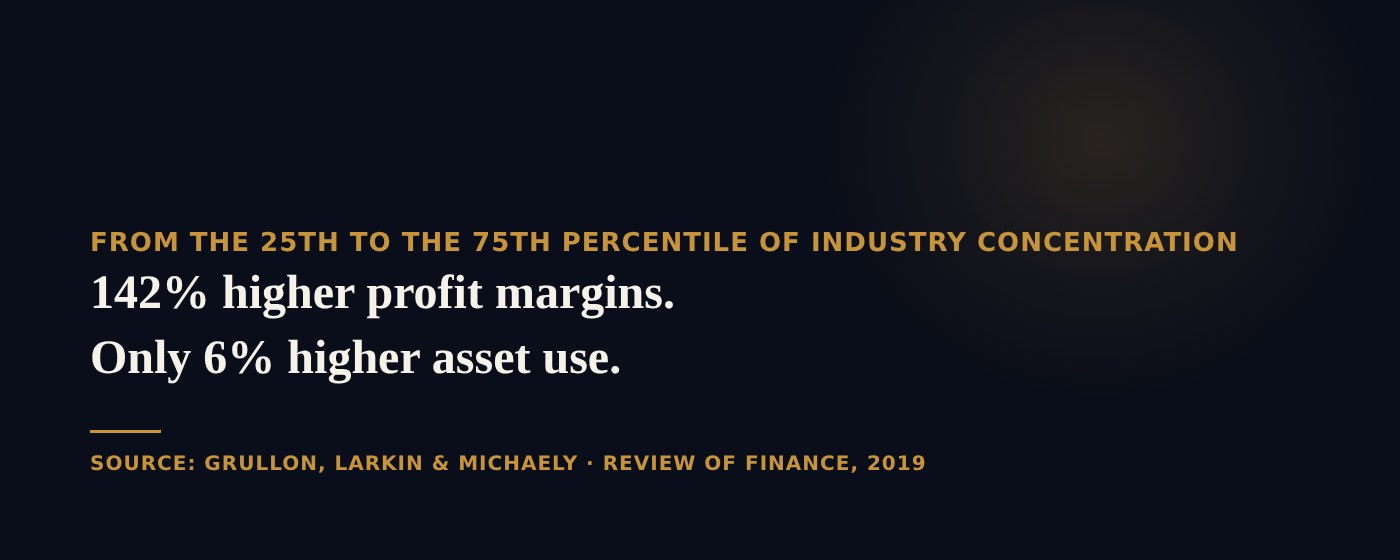
The 2019 study points to why a buyer can afford that. Going from an industry at the 25th percentile of concentration to one at the 75th went with 142% higher profit margins but only 6% higher asset use. The authors read that as profit coming from pricing power more than from running more efficiently.
In plain terms: owning more of a market tends to go with charging more for it. Your business may be worth more to a buyer than it is to you. That's worth knowing before anyone names a number.
What happens to prices after private equity buys in?
The clearest numbers come from health care. A 2022 study in JAMA Health Forum compared 578 physician practices bought by private equity with 2,874 that weren't. Afterwards, the bought practices charged about $71 more per claim (+20.2%), the amount allowed per claim rose about $23 (+11.0%), and visits rose 16.3%. Patients' risk scores didn't change significantly.
In veterinary care, the AAHA article reports an AVMA study that found more pressure to generate revenue, and lower satisfaction, in corporate clinics.
Regulators have noticed too. In September 2023, the FTC sued a private equity firm and an anesthesia company, alleging they bought up "nearly every large anesthesia practice in Texas" to raise prices. In January 2025, the private equity firm settled, with limits on its ownership and notice of future deals.
None of this means every buyer raises prices, or that the same will happen in your industry. Studies have found these patterns after some acquisitions, in some industries. What they do show is what a buyer can gain. That tells you something about what your business may be worth to them.

Should you take the buyer's call?
Yes. Take the call. Listening costs you nothing, and hanging up doesn't protect anything. What costs you is walking in without your own number. Before you share your books or sign anything, even a letter of intent, have your accountant and a lawyer look at it.
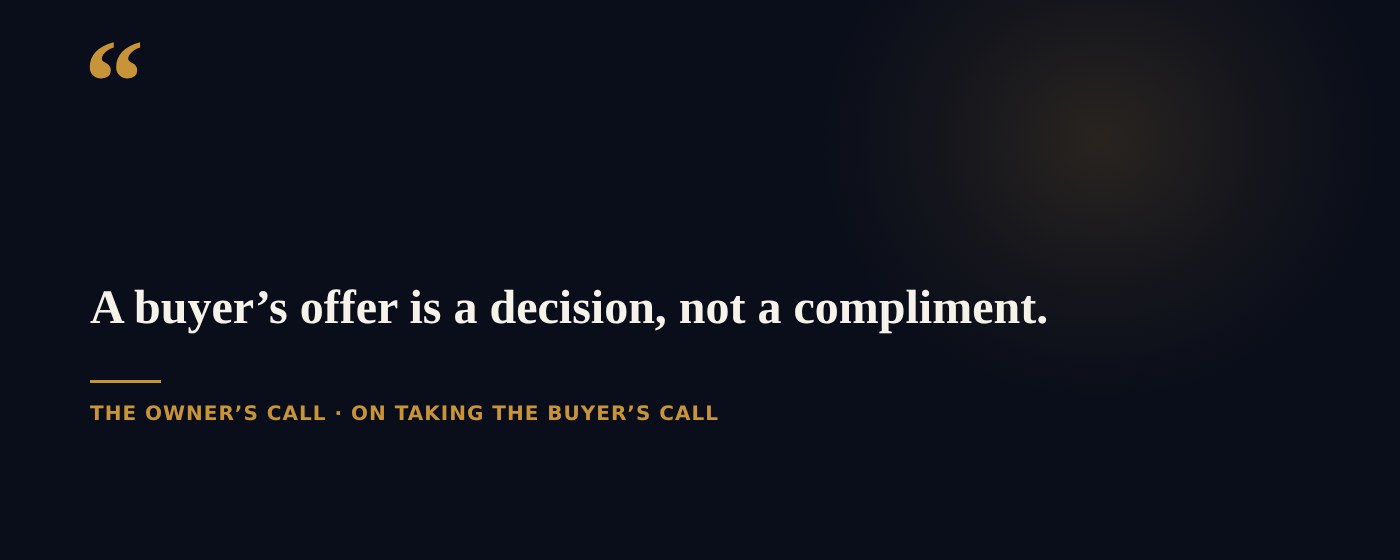
A buyer's offer is a decision, not a compliment. It feels good to hear that someone wants what you built. But they did their math before they dialed, and you should do yours before you call back.
My partners and I ran three small businesses over twenty years. In one of them, offers came in to buy the company while I was a partner. We weren't ready to accept. We had different ideas about our future, and we couldn't decide. If you have partners, settle what you want before a buyer calls.
What should you know before you call a buyer back?
Three things, and you can write all three down today:
- Your number. What the business actually earns, and what you'd need to walk away. Revenue isn't margin; it's the same lesson behind raising a price and explaining it once.
- Why they want it. Ask what your business adds to theirs. If owning more of your market is worth more to them than it is to you, the price should show it.
- What you'd be selling. Customers trust owners they know. In Gallup's 2025 survey, 70% of Americans had a great deal or quite a lot of confidence in small business; for big business it was 15%. That trust is part of what a buyer is paying for.
And if you don't decide, you've still decided. "Wait and see" is already a decision, whether it's about AI or about the letter on your desk.