Five Hardware Stores Teamed Up in 1924. It Still Works.
Small businesses get better supplier prices by buying together. A group of small owners who order as one can ask for the kind of price a big chain gets, and each owner still runs their own shop. Five Chicago hardware store owners started doing this in 1924, and the company they built, Ace Hardware, is still owned by its local stores.
Here's how it started, how it works, and how to use it if you don't sell hammers.
Why do big companies pay less for the same things?
A supplier saves its best prices for its best customers. A big chain orders a lot, orders often, and pays one bill for hundreds of stores. That's cheap to serve, so it gets a low price.
A small shop orders a little, now and then. Same box, same truck, higher price. The difference comes straight out of the owner's margin, every month.
You can't fix that by being a better negotiator alone. You fix it by becoming a bigger customer. And the fastest way for a small business to become a bigger customer is to stop buying alone.
What did five hardware stores do in 1924?
They teamed up. According to Ace's own 90th-anniversary release, Ace was "Founded in Chicago in 1924 by five independent hardware store owners": Richard Hesse, E. Gunnard Lindquist, Frank Burke, Oscar Fischer and William Stauber. They joined forces "to increase their collective buying power in the industry."
Ace's history page says what that bought them: it let individual stores "purchase merchandise in bulk to save money and buy at the lowest possible price."
The Encyclopedia of Chicago describes the founders as "Chicago hardware dealers who wanted to provide a centralized purchasing organization to supply their stores and others." Look at the last two words. They weren't building a club for five. They built something that could supply other stores too.
How did the stores end up owning the company?
They bought it. "After Hesse retired in 1973, Ace was sold to its retail dealers," the Encyclopedia of Chicago says. The Deseret News puts the change to a retailer-owned cooperative at 1973 to 1976.
That is still the deal today. In Ace's own words, "Ace Hardware Corporation is still owned solely and exclusively by the local Ace retail entrepreneurs."
So the stores are the customers and the owners at the same time. Whatever the buying group earns has somewhere to go: back to them.
Does buying together still work a century later?
Ace's results for fiscal 2025 say yes. Revenue was a record $10.0 billion, up 5.8%. The company ended the year with 5,250 Ace stores in the US, and it calls itself "the largest hardware cooperative in the world."
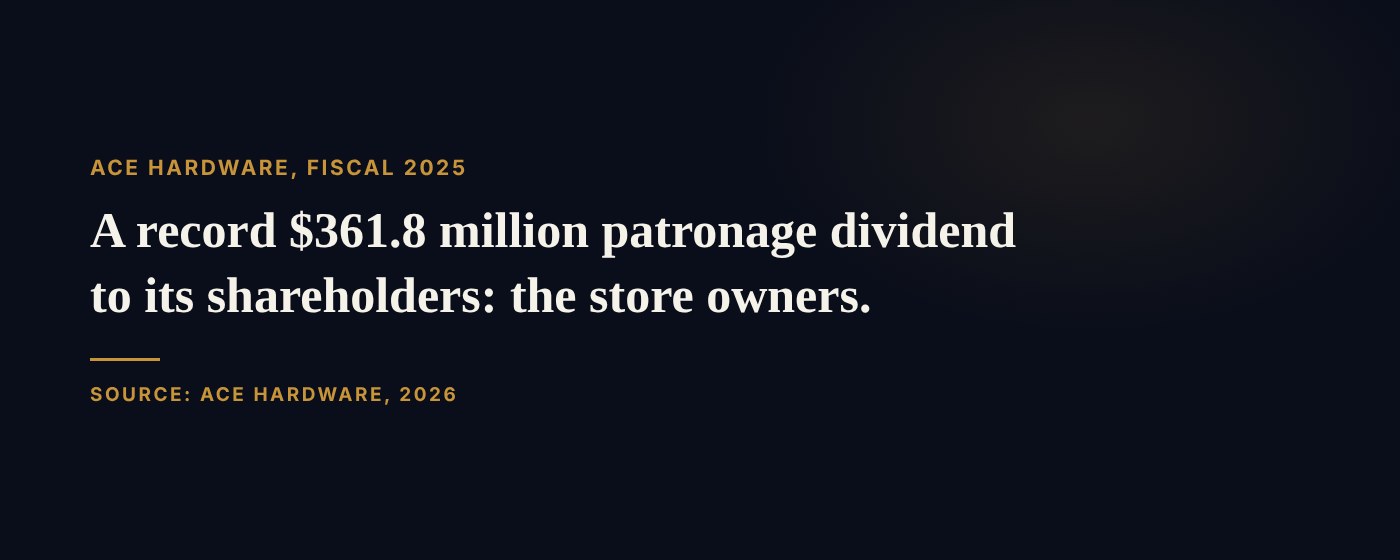
The number that matters most to a store owner is the money that came back. Ace paid a record patronage dividend of $361.8 million to its shareholders, who are the store owners.
What's a patronage dividend? Ace's filing with the SEC explains that it pays them to member dealers each year "on the basis of quantity or value of patronage business that we do with them." In plain words: the more a store buys through the group, the bigger its share of the money back.
A co-op isn't free money, though. It only works when members send a real share of their orders through it. The savings come from that commitment. A group that nobody buys through has no buying power.
Is this only a hardware store idea?
No. Independent grocers do the same thing. Associated Wholesale Grocers describes itself as "the nation's largest cooperative food wholesaler to independently owned supermarkets, serving 1,100 member companies and 3,500 locations throughout 33 states."
At its annual meeting in March 2026, AWG reported cooperative net sales of $11.6 billion and said it "distributed a record $293.1 million of year-end patronage." Its CEO, Dan Funk, put the idea in one line: "For 100 years, AWG's cooperative membership has empowered independent retailers to compete, adapt, and thrive together."
Two trades, one idea, both about a century old. Small owners who buy as a group get treated like a big customer.
How can a small business get better supplier prices without a big co-op?
Start with what you buy most. Then find the owners who buy it too.
- Restaurants and cafes: food, takeout boxes, cleaning supplies.
- Salons and barbershops: hair products, towels, card processing.
- Plumbers and electricians: fittings, wire, work vans, fuel.
- Landscapers and cleaners: equipment, fuel, supplies, insurance.
- Small shops of any kind: shipping, packaging, software.
Then take these steps:
- Look for a group that already exists. Ask your trade association and your suppliers if there is a co-op or buying group for your trade. Joining one is faster than building one.
- If there isn't one, start small. Find a few owners who buy the same things but don't chase the same customers: a different town, or a different niche. Pool one item first, not everything.
- Put it in writing. Who places the order, who pays, and how the savings are shared. Share them by how much each owner buys, the same idea as a patronage dividend.
- Talk about what you buy, never about what you charge. The group is for getting better costs. Each owner still sets their own prices. Rules on how competitors can work together vary, so check your plan with an attorney before you sign anything.
- Ask before you join. What does it cost to get in? How much do you have to buy through the group? How does money come back, and when? Can you leave?
A lower cost is the other half of a healthy margin. The first half is your own price, and how to raise it and explain it once. And if a big company calls to buy your business instead, start with Small Beat Big #1: why private equity is buying small businesses.